Performance Journal: Thursday

26 April 2018

I live-tweeted the dress rehearsal of the full program.

7:15 pm We’re rolling! Charity kicks off the dress rehearsal with the “Shout Dirge for Lady Macbeth,” the only one of the four songs that is about the real Lady M rather than Shakespeare’s Lady.

7:25 Now “The Song of the House Martin”–amazing duet for voice and clarinet, dirty and sultry.

7:30 Now “Lady, Maid, Invocation.” Lady M’s maid hasn’t slept in days & decides to do something about it: Come, you spirits!/ Tend to me and this my charge,/ this cruel and murdering woman./ Make steel my bones/ and smoke of hers/ that she will be/ gusted away/ over the parapets.

7:37 Once Lady M is dead, her maid can sleep “not tempest-tossed/but charm-wound with peace.”

7:38 The last of the 4 is “Cradle Carol for Lady M.” It begins attaca from the previous song w/cello tremolo on a harmonic. Where the house martin is snide, the narrator of this song has compassion for Lady M.

7:43 In 2 songs, narrator commends Lady M to heaven; in the others, death is her comeuppance or a relief.

7:56 Next up is Trigger. Today’s Bill Cosby’s news has emotions high–we’re all pleased by the verdict–and the case is referenced in this production of the piece.

7:58 Jennifer Sgroe has performed Trigger several times. It’s a difficult role, and she is excellent.

8:01 Trigger asks: “Did she deserve to get hit?/Did I?”  The answer is always no.

8:09 Short break before @MarieCurieOpera proper begins.

8:17 @HICOrchestra is warming up and tuning up. @MarieCurieOpera uses piano, violin, cello, flute, clarinet, and percussion.

8:18 @MarieCurieOpera cast and director taking some selfies on stage as everything gets set up for the final dress rehearsal.

8:28 Sound-checking Irene Curie’s aria, the loudest part of the opera… And now @MarieCurieOpera is off and running its final dress.

8:33 Marie and Irene are at the shore, where Irene is trying to convince Marie that they need time off.

8:39 @MarieCurieOpera sounding good! The balance is good; sitting in back to tweet, I can hear the orchestration better than last night when I was in the middle of the room.

8:46 Claudia Rosenthal’s Irene Curie expresses the character’s desire to relax & to get her mother to take a break really well, combining affection & a bit of pleading & frustration.

8:48 As Older Marie (Susan Yankee) watches, Younger Marie (Lizzy Hayes) & Pierre (Mark Womack) enter as a memory to sing about their meeting, courtship, & work together. Their excitement builds from here to the line “We won the Nobel Prize!”

8:52 Curies have good chemistry (sorry, I couldn’t resist), & the lab set-up looks great.

8:54 Hayes & Womack are hitting a home run in portraying the Curies tonight. They have great communication in their duet & the staging is solid. I am so happy with this.

8:55 Prob not a good idea for me to give them a huge thumbs up at the end of the scene, but I wish I could.

8:56 Here we go: Pierre’s aria. He’s so excited about what he thinks radium can do and sells it like Harold Hill.

8:57 I guess singers don’t really plan on careers singing about radium burns, but, you know….

9:00 They look at glowing radium (sourced from glow sticks) like a beautiful baby. In a way, it was.

9:02 Pierre’s death: Older & Younger Marie sing together, then share text between them, a dialogue between the past & present, a memory that has never faded.

9:04 Solo piano as the Maries circle each other on stage, Older Marie watching Younger Marie, then the quote from Marie’s own autobiography about the flowers Pierre left behind.

9:05 Now Older Marie sings of losing hope after Pierre’s death, but she ultimately finds continued purpose in her work.

9:09 Susan Yankee as Older Marie, remembering, compares the period after Pierre’s death to floating, unsure of what to do.

9:09 And now for my obligatory Shakespeare reference: Irene cites the seven ages of man.

9:12 Now for my favorite aria: Marie’s “I take my life in measurements/obscure to other women”! We’re slowing a bit tempo-wise, but I’m sure it’ll pick up a bit as this aria moves forward.

9:15 The textures here–sul pont on the cello, mallets–has a spare beauty that captures Marie’s sorrow well; then fuller ensemble returns as Marie discusses how she survived and continued her career.

9:23 Marie & Irene sing together in a lovely duet but to different ends: Marie wants to go back to work, but Irene knows they need rest.

9:26 Now it’s time for Marie’s rage aria! She rails against the conservative French press, cronyism, antisemitism, xenophobia, & sexism, but ends w her triumphant win of a second . Sing it, Marie!

9:27 Clarinet & cello at the bottoms of their ranges: deep, long-held anger, the kind that pushes you to show your oppressors that you are So. Much. Better. Than. Them.

9:29 Terrific emotional and musical anguish as Marie recounts how her lover’s estranged wife told the press that Pierre had killed himself.

9:34 Marie on her isolation of radium: “The little stars I had found had turned me into one.” Susan Yankee’s Marie is proud but exhausted.

9:37 Nearing the end, approaching Irene’s big aria about her fears that radium is hurting them. She & her mother both died of leukemia caused by exposure to radium.

9:42 Last tweet of the night: My heart beats fast w happiness & joy right now. I am very fortunate to have my work performed by such good musicians, & am grateful to everyone working on this production. <3

Friday we’re dark and we all rest (I hope). I may have a short post but will likely be back on Sunday with some final thoughts.
Performance Journal: Wednesday

Wednesday, 25 April 2018

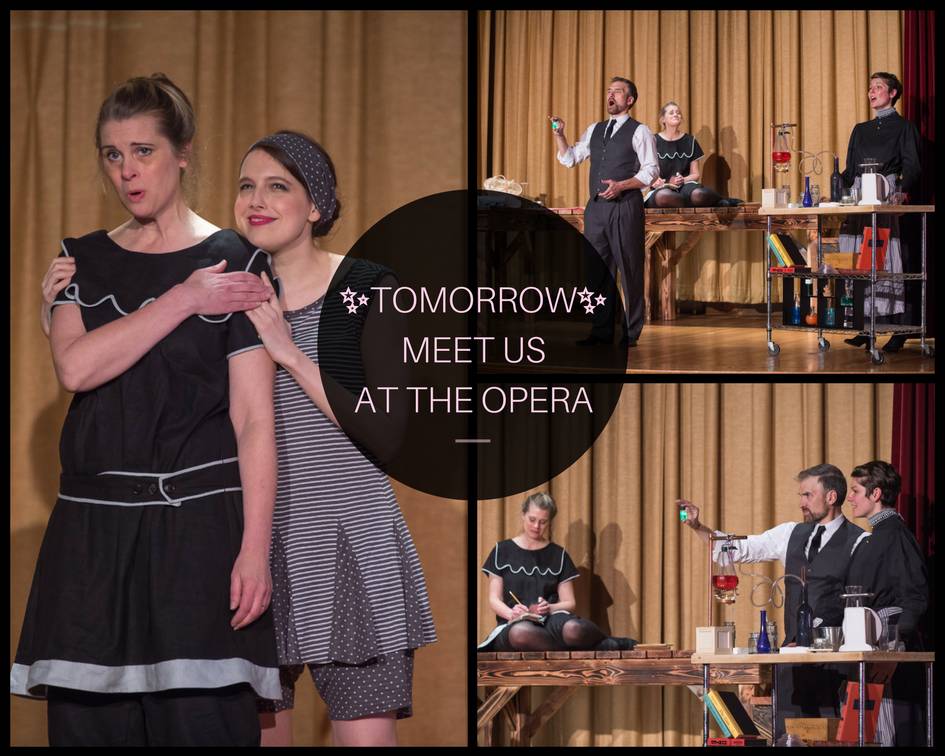
I was up early and on a plane by 7, laying over in Detroit and arriving in Hartford just before 4. After dropping my luggage off at my hotel (which has terrific staff but tries way too hard to be chic and swank but is poorly designed), I went to the performance venue. There had been a mix-up on the times performers were supposed to arrive so we got started late, but the delay gave me time to meet people in the production, most of them for the first time outside of online. Jessica and I caught up and I got to go up on stage and look at the set in detail—cosplayer genius and singer Jillian Swanson had sourced “lovely, glowing radium” that is going to look outstanding in the dark. The set has a raised dock for the beach, while the stage level itself is the water; off to one side is the lab where some of the flashbacks/memories take place. The costumes were all spot-on. I went over pronunciation of a few things with singers. A professional photographer, whose name I didn’t get, was shooting the rehearsal. The instrumentalists were all terrific.

The rehearsal began with Trigger. Kristy Chambrelli created an entirely new staging of it for this production, and it’s very effective. Jennifer Sgroe does a fantastic job with the role. I think many people think that domestic abuse—physical, psychological, emotional—remains rare. It isn’t. This piece should become a staple of the repertoire.

Charity Clark sounded great in the Four Songs for Lady Macbeth. She’s perfectly mournful and proud in the “Shout Dirge for Lady Macbeth,” which opens the set and is the only one of the four songs that draws on the historical Lady M rather than Shakespeare’s version. The narrator in the “Shout Dirge” is trying to set the record straight, correcting Shakespeare’s account of the Queen of Scots. The second song, “Song of the House Martin,” is a jazzy and sly bit: the martin who builds its nest in the castle rafters asks Lady M if she has not heard it singing throughout, as she wends her way to destruction. “Can you hear me in your great hall/Where you welcome home your husband/And build a plan on dagger points?” The martin can be sympathetic or sarcastic, and in this case sarcasm and irony drip from its tongue. Charity and the HICO clarinetist, Alex (whose last name I will get later—sorry!) dirty it up into a mocking litany. “Lady, Maid, Invocation” is probably my own favorite of the four poems: Lady M’s maid is sick of having to “give her all the soap” and watch her mistress wander around at night. Charity conjures up the desire for power, combined with some wariness, as she asks the spirits to deliver her from her dread employer. In the final song, Charity managed to convey both pathos and sympathy for Lady Macbeth in the “Cradle Carol for Lady Macbeth.” The text draws on the Coventry Carol as well as Shakespeare and the music is in the Locrian mode; Charity made it gloriously heart-wrenching.

Marie Curie ran from the top with several breaks for comments and re-sets. A few singers are coming in early in places, perhaps due to the balance in the room. I don’t know what it sounds like onstage, but the room is high and wide, and sometimes the piano gets a bit swallowed up under the rest of the ensemble. There were a few other changes—Young Marie’s first entrance being one—and some other adjustments. The tempos for both Four Songs and Marie Curie were on the slow side, which saps energy and drama out of a number of places, but that will be addressed tonight. I had a few notes for Kristy about the way some of the text is being sung, and she will work with the singers to make changes on these.

Overall I was really pleased with the singers’ work. Mark Womack as Pierre has created a compelling and personable role, balancing Pierre’s seriousness and excitement completely. Lizzy Hayes, who came in late to the production when we had to split the role of Marie into two, is a perfect young Marie, full of pride and excitement and straight-forwardness and a sense of self. Claudia Rosenthal has created an Irene who is also ideal: she manages the demands of the role—first trying to placate her mother and entice her into relaxing and enjoying a break from work and then, finally, breaking down emotionally while chronicling her fears that radium is killing them—with real emotional power. Older Marie is sung by Susan Yankee; her singing is clear and her acting is strong.

Jessica and I meet for dinner Thursday night to talk about notes for the rehearsal and then it’s the full dress.


Packing while disabled

This is a bit of an addendum to the post above. Tomorrow I’m flying from Houston, where I live, to Hartford, CT, for the final rehearsals and first performance of two pieces of music for which I wrote the lyrics and libretto. A person without chronic illnesses would pack clothes, basic toiletries, and tech stuff/chargers and would be done–in fact my husband just attended a wedding in Philadelphia for which he packed a suit, a few shirts, a sweater, a pair of dress shoes, toiletries, a book, and chargers into a duffel bag and had a lot of room left over. I, on the other hand, have to pack not only an appropriate wardrobe and necessities, but also:

  • A folding cane. Some days my balance and pain levels are not bad and I don’t need it. Other days I do. In areas that are new to me, are under frequent construction, are not well-maintained, or in conditions in which there might be rain, ice, or snow making surfaces slippery, I always use it. My cane folds up and fits into a pouch and goes into my backpack.
  • Heavy-duty noise-canceling headphones. The noise in airports and on planes often triggers migraines for me.
  • Industrial-strength earplugs, for when I can’t wear the headphones, like for sleeping.
  • Two shot kits. One is for toting around in my backpack or purse, containing one dose of my migraine rescue medicines. One dose is two pills taken orally and a liquid that I have to inject into my leg. This kit contains an alcohol wipe, a syringe, a glass ampule of liquid medicine (packed in cotton wool), a tool for breaking the top of the ampule off without cutting myself, a bandaid, and the oral medication. The second shot kit, which goes in my suitcase, contains multiples of all of these in case I have to take a second dose or have a second (or third etc) migraine while traveling. Things that trigger my migraines: loud, very high-pitched, very low-pitched, or pulsing sound or music (no nightclubs for me); excessive vibration (think driving down an unpaved road); cigarette or cigar smoke; flickering lights (strobe lights and strobe effects are a nightmare); several foods/drinks (which I can avoid most of the time); and stress let-down. Stress let-down migraines are my most common. These occur after a stressful event or experience–even if that event is something you’re pleased to be doing. I often have stress let-down migraines after coming home from a conference, after I’ve turned in a book or article manuscript, and other things like that. I can predict them. but not prevent them. Not entirely. Which brings me to:
  • A pharmacopeia of my daily medicines, including drugs for migraine prophylaxis and pain medications.
  • Gloves. If I’m going to be in a place that is kept cool–like most archives are–fingerless gloves help keep my hands from becoming really painful while still allowing me to type.

It can be a lot of packing.