Packing while disabled

This is a bit of an addendum to the post above. Tomorrow I’m flying from Houston, where I live, to Hartford, CT, for the final rehearsals and first performance of two pieces of music for which I wrote the lyrics and libretto. A person without chronic illnesses would pack clothes, basic toiletries, and tech stuff/chargers and would be done–in fact my husband just attended a wedding in Philadelphia for which he packed a suit, a few shirts, a sweater, a pair of dress shoes, toiletries, a book, and chargers into a duffel bag and had a lot of room left over. I, on the other hand, have to pack not only an appropriate wardrobe and necessities, but also:

  • A folding cane. Some days my balance and pain levels are not bad and I don’t need it. Other days I do. In areas that are new to me, are under frequent construction, are not well-maintained, or in conditions in which there might be rain, ice, or snow making surfaces slippery, I always use it. My cane folds up and fits into a pouch and goes into my backpack.
  • Heavy-duty noise-canceling headphones. The noise in airports and on planes often triggers migraines for me.
  • Industrial-strength earplugs, for when I can’t wear the headphones, like for sleeping.
  • Two shot kits. One is for toting around in my backpack or purse, containing one dose of my migraine rescue medicines. One dose is two pills taken orally and a liquid that I have to inject into my leg. This kit contains an alcohol wipe, a syringe, a glass ampule of liquid medicine (packed in cotton wool), a tool for breaking the top of the ampule off without cutting myself, a bandaid, and the oral medication. The second shot kit, which goes in my suitcase, contains multiples of all of these in case I have to take a second dose or have a second (or third etc) migraine while traveling. Things that trigger my migraines: loud, very high-pitched, very low-pitched, or pulsing sound or music (no nightclubs for me); excessive vibration (think driving down an unpaved road); cigarette or cigar smoke; flickering lights (strobe lights and strobe effects are a nightmare); several foods/drinks (which I can avoid most of the time); and stress let-down. Stress let-down migraines are my most common. These occur after a stressful event or experience–even if that event is something you’re pleased to be doing. I often have stress let-down migraines after coming home from a conference, after I’ve turned in a book or article manuscript, and other things like that. I can predict them. but not prevent them. Not entirely. Which brings me to:
  • A pharmacopeia of my daily medicines, including drugs for migraine prophylaxis and pain medications.
  • Gloves. If I’m going to be in a place that is kept cool–like most archives are–fingerless gloves help keep my hands from becoming really painful while still allowing me to type.

It can be a lot of packing.
 

Performance Journal: Tuesday

Tuesday, 24 April 2018

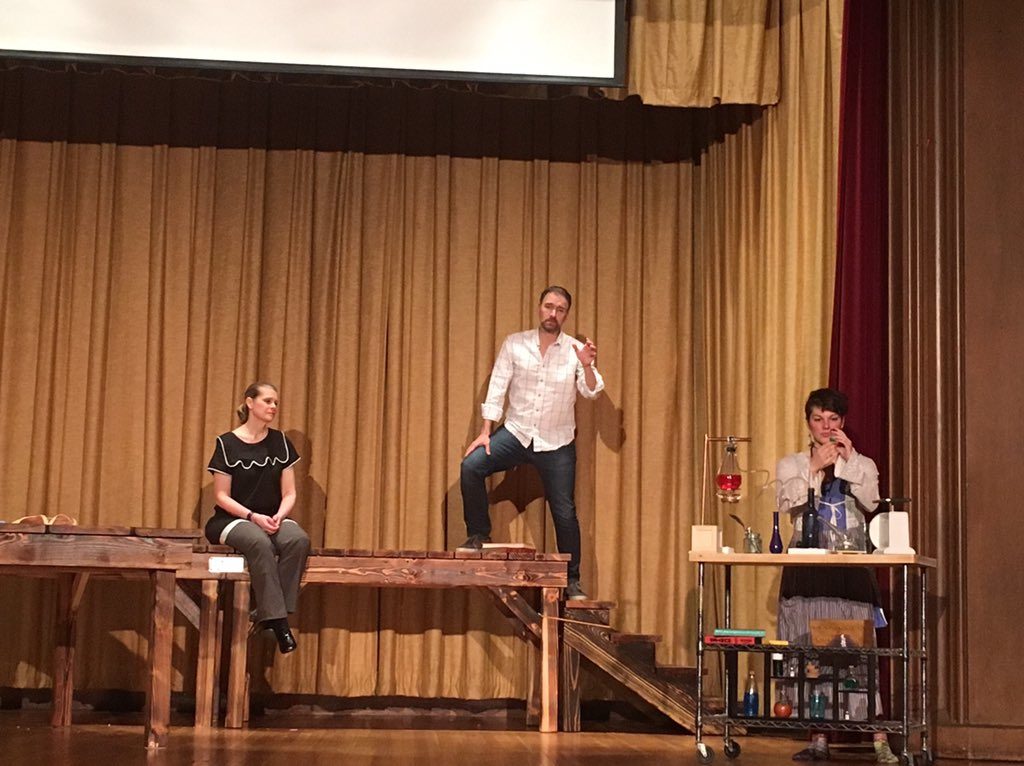
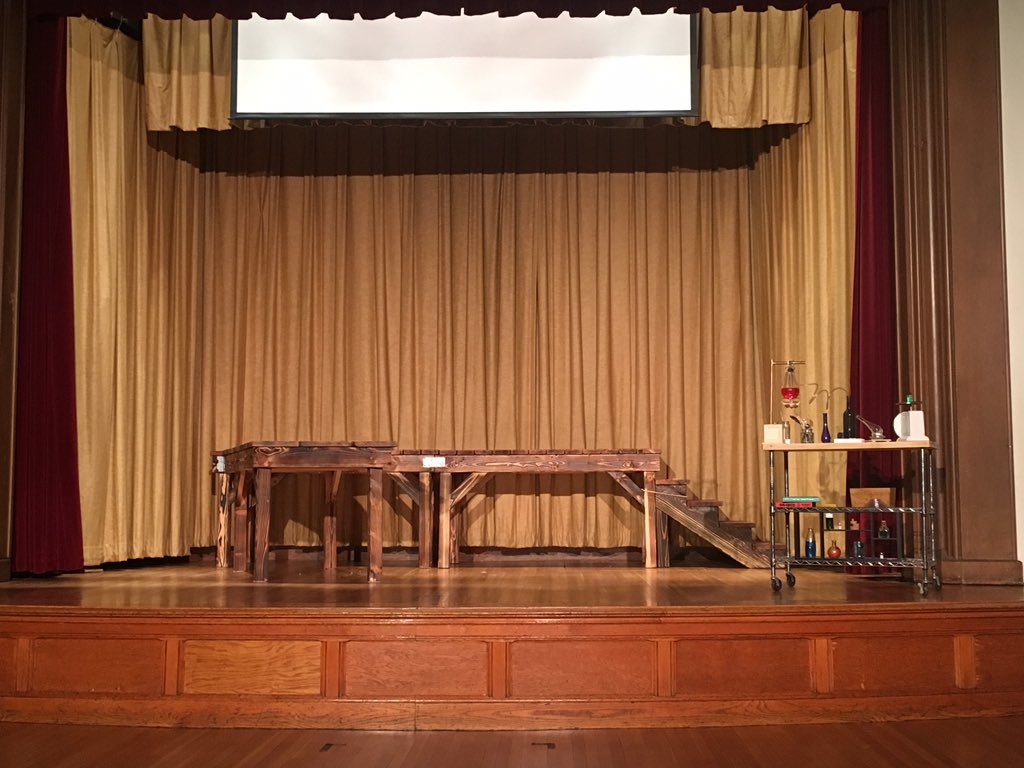
Here are photos from last night’s rehearsal, showing the lab cart and a raised platform that I think represents the beach—the stairs must be where Marie and Irène enter the water for the swimming lessons. I’ll have more starting tomorrow or Thursday, after I arrive in Hartford. On the schedule today is the sitzprobe, the first rehearsal in which the singers and instrumentalists rehearse together.

The set for Marie Curie Learns to Swim at the Hartford Opera Theater premiere.
L-R: Susan Yankee (Old Marie Curie), Mark Womack (Pierre Curie), and Elizabeth Hayes (Young Marie Curie)


In addition to the research I did on horrifying radium products like the ones shown yesterday, I read a lot about the Curies. Marie wrote a biography of Pierre after his death, and included with it a short autobiography. I didn’t want to be tied to her actual words too often (given my training in musicology to cite directly, this was a very different writing approach), but there was one place in particular where I felt that Marie expressed her grief over Pierre’s death so beautifully that there was no improving upon it or paraphrasing it. She sings

In the study room
to which he would never return
the water buttercups
he had brought
from the country
were still fresh.

If this were a film, I’d want a long shot lingering over the flowers, perhaps with Marie’s fingers reaching out to touch them and not quite doing so—just hovering above or near them. In the opera, Jessica sets this perfectly: a whole step separates “in the” and then Marie, her voice breaking, goes up a minor sixth for “study” and from there descends through the line to sing the “turn” of “return” her initial starting pitch on E-flat. There’s an eighth rest in the vocal line—completely devastating—and Marie begins the second phrase a whole step lower, again rising, this time a fifth, to “butter;” and she descends to an F for “country.” Another heart-wrenching eighth rest, and then “were still” descends a whole step. Marie then pauses for a quarter rest, obviously so choked up she can hardly speak, before singing “fresh” on a low C-sharp. The accompaniment is dominated by a crawl of eighths in the bass, each measure beginning at the bottom of the cello’s register that refers to material that originated in the section where Marie sings of meeting Pierre, and their duet, which you can hear in MIDI while looking at the score here: http://www.mariecurieopera.com/2017/07/24/composers-log-july-24-2017/. I know this will make me cry when I hear it: I’d better remember to pack a handkerchief.

Tomorrow I fly to Hartford, arriving in the afternoon and hoping I can get to the rehearsal to hear it all from the beginning. On Thursday at the full dress we’ll have a videographer and audio recording people in to capture everything. The video and audio from the dress and performance will be edited to create a sample that we can use to promote the opera to other opera companies after the HOT premiere.

To prep for being at rehearsals, I’ve re-read the whole libretto (where of course I found a repeated typo) and am going through the piano-vocal score today. (I thought about printing it out to take notes on, but it’s just too much paper for me to feel good about. This is one time when I really wish I had an iPad pro with the pencil. One of these days.) My role is mostly to answer any questions the performers have about the text, the characters, and the topic as a whole. I hope my being there will be helpful to everyone. In my scholarly work on Shakespeare, I’ve always found the idea of being a dramaturg appealing, and while that isn’t my role with this production of Marie Curie, I could see doing that one day for a production of it. I’m really looking forward to tomorrow’s rehearsal.

Tomorrow’s (Wednesday’s) post will come late in the evening, but I hope to have a lot of photos and observations to share.

Performance Journal: Monday

Monday, 23 April 2018

Today the production moves into the performance space at Christ Church Cathedral in Hartford and begins to set up. Over the next few days, the singers will be learning how the blocking works in the space, and both the vocalists and instrumentalists, conducted by Dan D’Addio, will be learning how the acoustic of the space works, and starting to run all three pieces all the way through in preparation for the performance. The production staff is getting all of the props and set materials finalized. Director Kristy Chambrelli is keeping everyone focused and calm, making sure each rehearsal progresses.

There will be a lab set that comes on stage three times. The props for it include beakers, bottles, bowls, tweezers, spoons, and glow sticks. Yep, glow sticks. Curie repeatedly referred to the “fairy light” and “glow” of radium. It enchanted her: she carried vials of isolated radium around in her pockets even when she wasn’t working in the lab. Curie’s own lab notebooks and even household objects are still so radioactive because of their proximity to her work with radioactive elements that in order to work with them, researchers have to wear protective clothing and limit their exposure time.

This glow was seductive. Before people recognized the risks of radium, it was hailed as a healthful cure-all. As Pierre Curie sings:

We can use it
for the truly ill—
to cure
TB and VD and strep,
arthritis and gout,
to hasten the knitting of bones,
to help the weak grow strong,
to give energy to the fatigued.

It will remove your growths, your grey hair!
It will warm your cold, sore feet!
It will improve your sex drive!
It will cure your shakes!

Drink it in your water!
Smooth it on your face!
Add it to your butter,
add it to your paint,
bathe in salts that gently glow

bathe in its gentle, healing glow.

Jessica knew immediately what kind of tone Pierre’s aria should take: he needed to sound like a stereotypical used-car salesman. He also needed to sound like he really believed in all of this—which he did—but at the same time, he needed to sound just that bit over the top in selling a product whose properties he knows he truly doesn’t fully know yet.

Pierre Curie was largely self-taught, a self-motivated polymath who could be interested in dozens of things at the same time or deeply focused on a single idea. His mind was, as my scientist spouse puts it, full of cats all chasing individual red dots. At the same time, Pierre could be lazy: he’d figure out something to his satisfaction and abandon it without writing up his findings or publishing them, moving on to the next thing. In the opera, he sings

My education had been haphazard:
it was not broad but deep.
And when struck with an idea
I could lose myself in it forever,
forgetting everyone and everything else.
I believed that fate had chosen me to
delve into most mysterious questions
of the universe.

Among other things, he was interested in theosophy and spiritualism and using scientific instruments to prove the existence of ghosts.

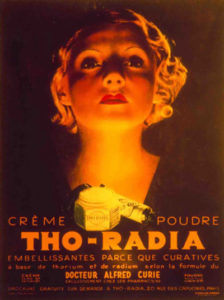
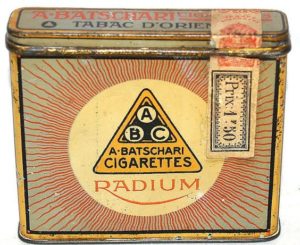
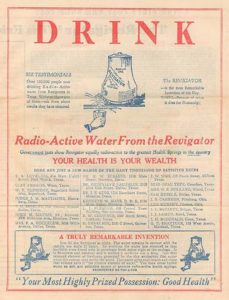
Marie had to push him to finish his doctorate so that they could get the funding needed for their research. Even then Marie did a good deal of the actual lab work while Pierre sought out potential funders and talked up the amazing things they could do with radium. Some advertisements and products of the period speak to the Curies’ hopes:

Alfred Curie–no relation to Marie or Pierre–nonetheless capitalized on their name in selling Tho-Radia beauty products worldwide.


Radium-fortified butter and other foodstuffs were sold during the early 1900s.
Radium cigarettes


A method for infusing your water with radium.
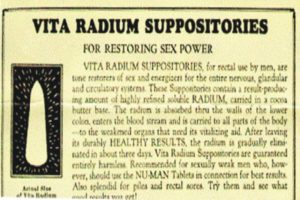
Various radium products were said to invigorate your sex drive.


Today, many people have read or heard about the “Radium Girls,” women who worked in watch-making factories during the 1910s and 20s painting the watch faces with radium paint. To shape their brushes to very fine points, their bosses encouraged them to use their lips, telling them to “lip, dip, paint,” to save time and money on shaping brushes with rags or dipping their brushes in water. The workers also painted their nails with radium paint and sometimes used it on their faces. This led to radium poisoning and devastating consequences: women’s jaws disintegrated, their spines collapsed, and they developed various cancers. Their lawsuit against their employers over workplace safety was a major landmark in labor history.

But Pierre died before these dangers were confirmed—and Marie never admitted that her “beautiful radium” could be so dangerous, which is a major point of the opera.

Tomorrow: on using Marie Curie’s own words.