I was interviewed by VoyageHouston about my work and living in the city. I talk about my journey as a creative writer, living with lupus, collaboration with great folks like Lisa Neher, Jessica Rudman, George Harvey, Stephen Vincent Casellas, Double Reed Dish, and my upcoming premiere of “Girls Love Horses” with Nanette McGuinness and Ensemble for These Times. Read it all here.
Theaterkrant review of the One Voice Project Micro-Opera Festival
Critic Thea Dirks reviews the One Voice Project Micro-Opera Festival, giving it the Critics’ Choice Award! Read here for the original Dutch or below for an English translation.
Lisa Neher, Kendra Leonard
One Voice Project Virtual Micro Opera Festival
STRONG WOMEN IN GRASSROOTS MINI OPERAS
Seen on March 22, 2021, online

Theaters and opera houses have been closed for over a year. The American singer and composer Lisa Neher and the librettist Kendra Leonard organized the One Voice Project Virtual Micro Opera Festival . With little means they realized an extremely varied series of five mini-operas for unaccompanied solo voice.The project is thus related to the eight-part series Bonsai Garden with which Jan-Peter de Graaff responded to the lockdown last year.
With the initiative, Neher and Leonard want to offer us some beauty and give themselves and others the opportunity to practice their trade. The ladies have thought carefully about the production. As soon as you have applied for a – free – online festival pass, you will have access to a lot of information about the makers, the operas and the performers. From 22 to 26 March, they will send a new link to a world premiere every day. The operas are offered free of charge according to the pay as you can principle and remain available on YouTube.
The chosen subjects are very diverse and partly came about in consultation with the singers. For example, tenor Hugo Vera moved to Los Angeles in the middle of the pandemic. Leonard incorporated the associated uncertainty, loneliness and confusion in her libretto. In Wide Awake in the New City , we see Vega somewhat lost between moving boxes and haphazardly placed furniture in his new apartment.
“Sorry we had to drive so long,” he sings to his cat Eloise. Doubtful he worries about the lack of friends and about his new job, in which he has to teach virtually. But as soon as he steps onto his balcony, the prospect of one day being able to sing again at the renowned Disney Hall turns him on, ‘I can do this. In time we’ll figure it all out ‘, he sings in appealing coloratura.
The three following operas have a feminist-historical touch. Par for the Cause is about the athlete Babe Didrikson Zaharias (1911-1956). She excelled in many disciplines, but was best known as a phenomenal golf player. When she qualified for the US Open in 1948, the rules were changed so that only men were allowed to participate. The opera zooms in on the moment it learns – from the press – that it is excluded from participation.
Wearing an orange blouse and a pepi-plaid skirt, the soprano Audrey Yoder sings about her frustration. In flawless, big shots, she satirizes men’s fear for her performance: “I can even beat you in javelin throwing!” – Behind her we see archive footage of the javelin throw with which Zaharias won a gold Olympic medal in 1932. Self-confidently, Yoder sums up her many successes, citing with a wearily falling glissando the criticism that female athletes are ‘unnatural’.
The Momentum , sung by Lisa Neher herself, is about the 1967 Boston Marathon. Kathrine Switzer (1947) registered under her initials. When an official found out that she was a woman, he tried to force her out of the race. She nevertheless ran it out and five years later women were officially admitted as participants. Neher announces the video with a bit of emotion; she is an avid marathon runner herself. The camera follows her along desolate streets and industrial estates as she intersects her vocal indignation with impressive puffs.
Just as determined is the mezzo-soprano Margaret O’Connell in Woman Waits With Sword . The noble Alberte-Barbe d’Ernécourt (1607-1660) defended her estate as Chevalier de Baslemont against French, Swedish and Croatian soldiers. And against an intruder who thinks one day that he can take possession of her castle. With no more than a three-edged hat-with-feather, O’Connell portrays this man whose macho behavior makes fun of them. Finally, she challenges him to a duel: with a drawn saber and a powerfully raised arm, she looks into the camera. Bring it on!
In the fifth opera, Now Available , we return to the here and now. The tenor Zach Finkelstein seems trapped in his dire room. He looks out of the window in despair and sings about the closed theaters, the lack of bright spots, the fear of losing his skills as a singer. ‘I’m still singing… in my living room.’ Leonard also criticizes the opera houses that rarely compensated for the canceled performances. “Can I ever trust them again?”
One Voice Project Virtual Micro Opera Festival is a great piece of grassroots music theater. Without subsidy and advanced technology, the makers have made five beautiful miniatures, in which everything is right. As simple as the setting is, the lighting, camera work and sound recording are pico bello. Neher’s vocal lines are varied and followable without being coquettish and connect seamlessly with the often rapidly changing emotions. The singers are without exception excellent, with the star O’Connell, who draws attention with her particularly empowered rendition of the female Chevalier.
Go see that, hear that!
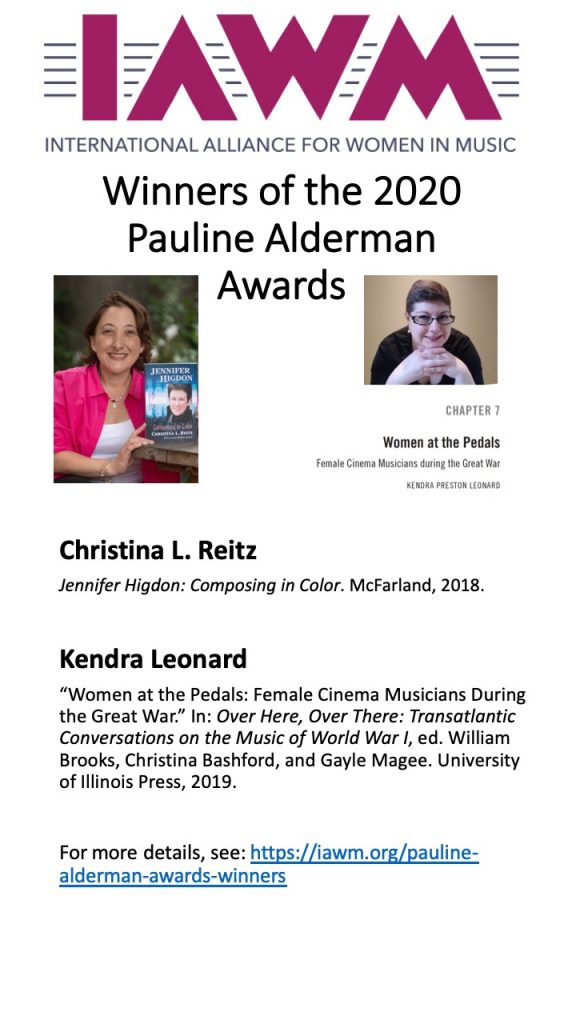
Pauline Alderman Award
I’m honored and delighted to have received the International Alliance for Women in Music‘s Pauline Alderman Award for Best Scholarly Article or Book Chapter for “Women at the Pedals: Female Cinema Musicians During the Great War,” which appeared in Over Here, Over There: Transatlantic Conversations on the Music of World War I, ed. William Brooks, Christina Bashford, and Gayle Magee, University of Illinois Press (2019). You can read an uncorrected proof copy of the chapter here.
The jury writes: “This book chapter investigates the women composers/improvisors who accompanied silent films during the First World War while the men were away at war. Their music, publications, and technical inventions (such as patents for piano roll systems) have previously been overlooked. Kendra Leonard’s research sheds a fascinating light on the role that women played in developing film music, demonstrating women’s pioneering, transformative, and subversive efforts. The work is meticulously researched and wonderfully written. In the words of one adjudicator, ‘The author makes a very important and strong contribution to the scholarly understanding of women and gender and music. In the process, Leonard recuperates a forgotten history and opens the door for more research to emerge.'”